


K Grieve • April 22, 2025
 Winnipeg: A Burger Joint With A Story
 
You can’t ever underestimate the influence of where and when you grew up. Childhood memories and experiences help shape our world view and create a blueprint for life. My childhood time in my hometown of Winnipeg Manitoba is certainly no exception! It is filled with positive nostalgia and yes, more than a few regrets. But this story is about fond moments and lasting impressions.
 
Nested in the heart of Canada’s prairies, Winnipeg has recently been called one of our country’s best kept secrets (Winnipeg: A Hidden Gem in the Heart of Canada). At its center lies The Forks, an historic meeting place at the confluence of the Red and Assiniboine rivers. 

This vibrant area is alive with multiple family-friendly features from a children’s museum to funky boutiques and the Winnipeg Goldeyes baseball stadium. A focal feature of the Forks is the Canadian Museum for Human Rights.
Creator: JOSELC  Copyright: JOSEL MEDIA

Created by an astonishing fundraising program lead by the very determined Gail Asper and a commitment from the federal government to designate it as a national museum it is notable as a national learning center. This architectural wonder is dedicated to highlighting human rights around the world. It serves as a metaphor for much of what Winnipeg is noted for: a commitment to the arts, social justice, multiculturalism and education. 


Photo from CHVN Radio Written by Vanessa Friesen Monday, Oct 17 2022

One of the earliest pieces of the city’s public art is the iconic Golden Boy. Perched atop the dome of the provincial legislative building, and designed in 1918 by Georges Gardet, it is over 17 feet high. The bronze statue features a nude young man reaching northward with a torch in one hand a sheath of wheat in the other. It stands for goals for prosperity and entrepreneurship- characteristics of many of Winnipeg’s early people: Indigenous peoples, Ukrainians, French, Poles, Scots and many more.


It is the entrepreneurial spirit that was behind the impetus for Winnipeg’s enviable public art. A walk around this wonderful city confirms its dedication to urban art and celebration of the city’s history and accomplishments. 


Winnipeg’s public arts installations were funded by outstanding and enviable fundraising from all segments of the city. This project was spearheaded by prominent local families and strong support from generous everyday citizens. The array of public art installations enrich Winnipeg’s urban landscape and reflect the community’s spirit and pride for cultural expression.


Internationally renowned Chinese artist Ai Wei Wei contributed the incredible piece “Forever Bicycles“ to the area surrounding the Canadian Museum for Human Rights.
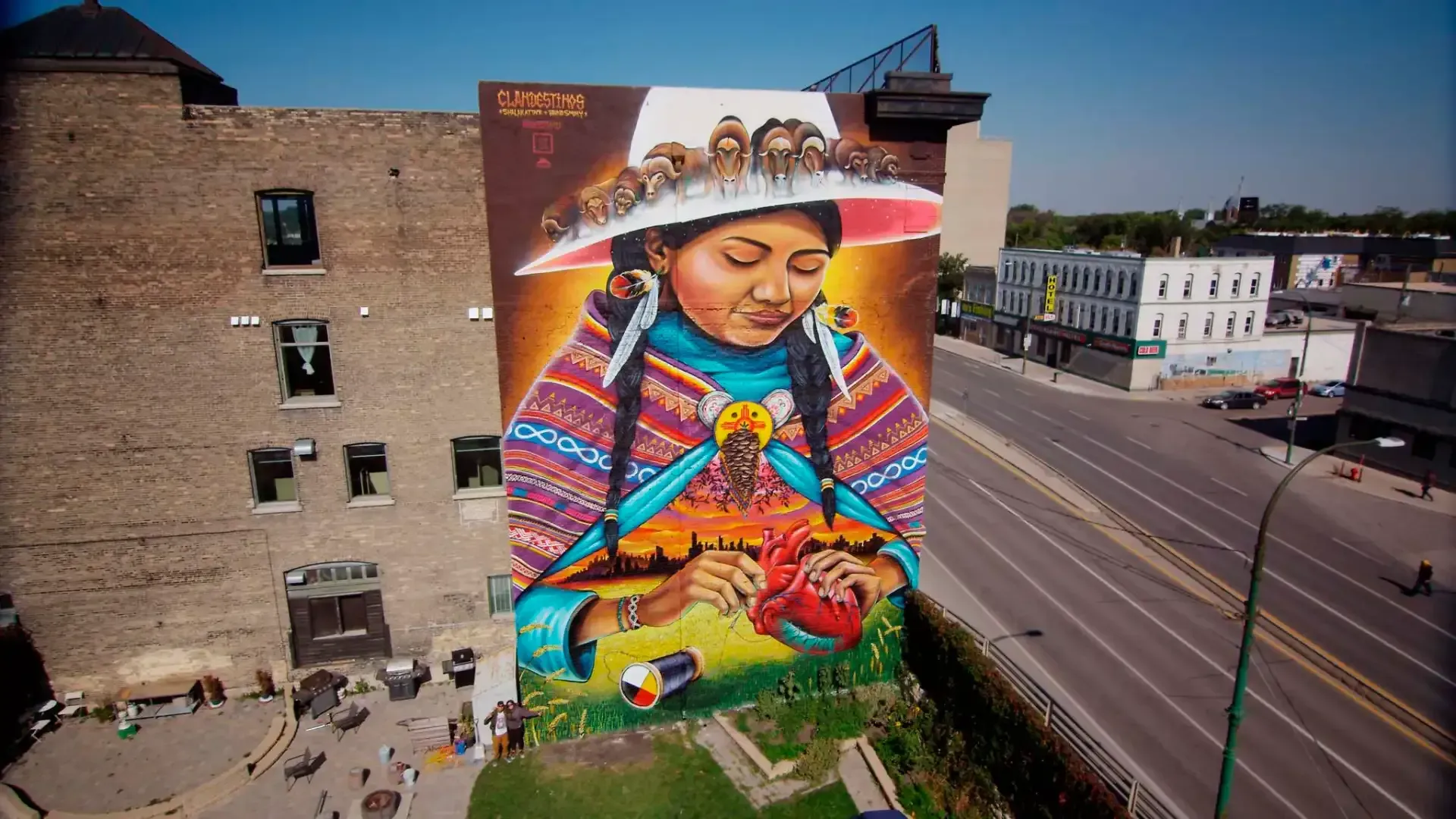

Nic Kriellaars photo Mending is a 50-foot tall mural on the wall of Winnipeg Centre Vineyard Church. The subject looks down at us with love, sorrow and beauty as we enter the North End. -From Winnipeg Free Press january 4th, 2020


Adding to Winnipeg’s unique charm are its renowned burger joints. One of my favorites is the famed Salisbury House. Famous for their juicy burgers, called “Nips” a classic order at the “Sals” was a nip and chips. Open 24 hours, the food outlet’s advertising song “Under the Little Red Roof” regaling its famous duo is pure nostalgia for me. Here is their legendary jingle performed by a family friend as she remembers it.


CLICK ON THE TRIANGLE ICON BELOW TO PLAY THE JINGLE!
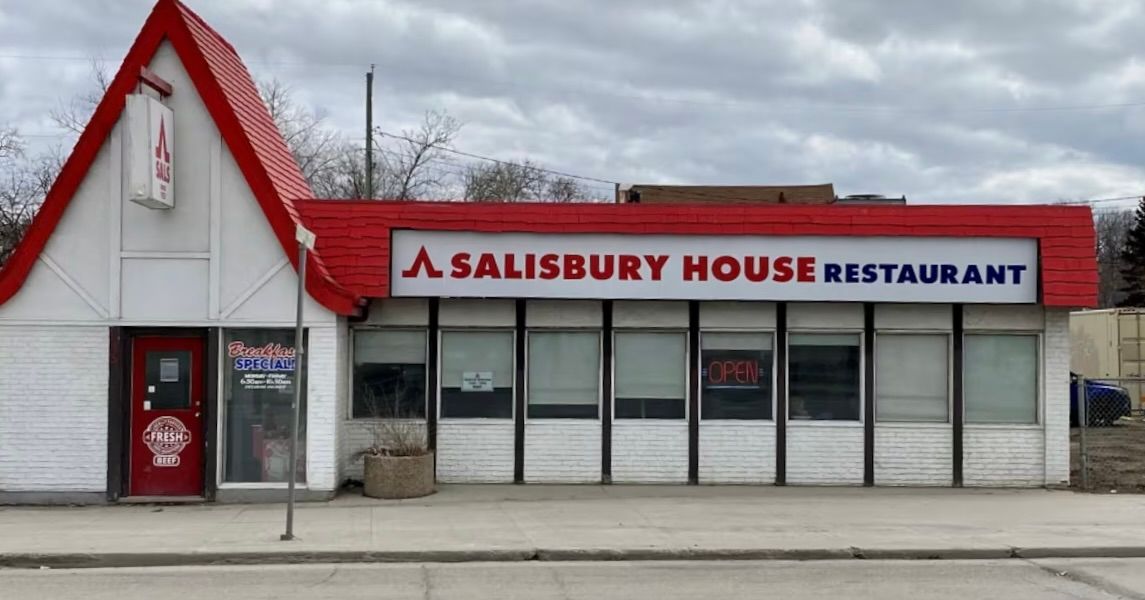

There are countless stories surrounding the “Sals” mostly involving late night, drunken visits after the pub. One friend of mine recalls a “Sals” incident.  


  • - -


‘Maria’s’ (pseudonym) Story:


“We went to the Salisbury House on Pembina Highway about two in the morning after the disco- we decided to have a nip and some fries and maybe some coffee to sober up lol 

We decided it was a good idea at the time to stand up and go without paying, we called it “eat and bolt”!

Crazy times!!! I don’t know why we did it. I still owe them the money ha ha. My first and only time I’ve done that.🤫”


- - -


Tom’s (pseudonym) ‘Right of Passage’ Story:


Currently a well respected Winnipeg resident, Tom (pseudonym) fondly recalls an impactful “Sals moment.”

“I was living in Winnipeg, attending Kelvin high school, and I got my drivers license in mid March.


Every weekend I would go with some friends to dances at community clubs at River Heights, Crestwood, Saint James, Civic Center, and University of Manitoba Student Union building. After the dances, we would go to either the A&W or the Salisbury House on Pembina Highway. In those days the Salisbury house had carhops who would come out in the middle of winter and deliver your order on a tray which you put on the side the car’s window. After your drinks came to the car, you would roll the window up with the tray on it in order to keep the car warm. If you didn’t get the drinks in quickly enough, the mugs would become ice cold.


The first day my parents allowed me to drive their car without their supervision was on a Friday night. After the dance we attended, three friends and I went to the Salisbury house and had a big nip, a chocolate donut and a root beer.


The car was parked in one of the spots near the building where the food was prepared. As I pulled out to leave, the car next to me also pulled out and backed into the side of the door of my parents’ car. This caused quite a bit of damage. I then had to go home to explain to my parents how, on my first time with their car, I had been in a car accident in the Salisbury House parking lot…


…it didn’t happen again.”


- - -


Sassy’s Story:

My Salisbury House story leans in a little different direction. It was July of 1975. Unlike the frigid cold of Winnipeg winters, the summers are hot and humid. My home was old, built on a twenty five foot lot on an elm tree lined street. Needless to say, this two story “historic property” was long on character and short on HVAC! I was in my home and the heat was so stifling that I could not sleep. After tossing and turning until midnight, I decided to head to my air conditioned local Salisbury House that was conveniently located right around the corner.


I sat at the counter on one of the backless seats and ordered a soft drink. The server was friendly and we chatted about the weather and our favorite tv shows. I sat happily cool and enjoying my solitude until the server returned and interrupted my reverie. She placed a piece of the Sal’s signature flapper pie in front of me. “Compliments of the gentleman at the far end of the counter” she quipped. I took this as a compliment and so gave a smile and a quick wave to the guy. I enjoyed that delicious desert and left my seat and headed home.


Fast forward to midnight the very next night and again my house was sweltering. Once more I sought a reprieve from the oppressive heat and returned to the Salisbury House and found the very same counter seat and placed the identical order. The same woman served me and we took up a short conversation where we left off. And then: Guess what? She placed an entire flapper pie in front of me!! 


Talk about one-upmanship: the server told me that that gentleman had been there the night before, and witnessed the single piece of pie the other guy had given me. Well, tonight this second gentleman decided to up the ante and sent over an entire pie!


I thanked him for his kindness and generosity and we had a good laugh before I left. Great memories at an iconic Winnipeg burger joint.



Winnipeg, a city rich in history and culture, is known for its public art, including the iconic Golden Boy and Ai Wei Wei’s “Forever Bicycles.” The city’s entrepreneurial spirit is evident in its vibrant arts scene and beloved burger joints, particularly Salisbury House, famous for its “Nips” and “Chips.” Salisbury House holds a special place in the hearts of many, including me. To this day, it serves as a nostalgic gathering place for late-night meals and cherished memories.

is loading comments...

Kathy's Blog

By K Grieve February 20, 2026
“Helen Mirren, who turned 80 in 2025, rejects the term “aging gracefully,” preferring to describe her approach as "aging with fun, commitment, and unapologetic realism". She advocates for embracing the natural process of getting older as a "beautiful thing" rather than fighting it, encouraging others to live in the moment and accept physical changes.” Aging is not for the faint of heart! It creeps up on you before you actually know it’s happening. It demands courage, boldness, wisdom, resilience, and realism. Add to that, growing older centers on the stories you carry and the memories you hold. For me, many of those lessons were learned from stories about my mother’s life, her choices, and the way she met hardship and joy. How Mom lived her life gave me my first understanding of what it means to live and to age with determination. My mother Marjorie lived until 95. Mom’s married life was pretty much emblematic of her generation. A devout Catholic, she learned the hard way that the ‘Rhythm Method’ (the practice of choosing specific days for intimacy to avoid pregnancy) of birth control was not in the least dependable. Think five kids with the last, our youngest brother Doug, born when my mom was 40. She smoked Crave M cigarettes. Back then, you could send a kid to the local drugstore with a quarter and a note to the pharmacist to get your cigarettes. Unheard of in today’s world. Almost weekly, my mom made homemade bread which filled the house with a yeasty and comforting smell. And her doughnuts were the talk of the neighborhood. Deep-fried and laid out on brown paper to cool, she dipped them in sugar, and we ate them while they were still warm. It was one of Mom’s ways of showing us love: one delicious donut at a time! My mom’s early life was less typical. Born in 1921 in Saskatchewan, she was a child of the Dust Bowl era. The middle child of six kids, she had a pleasing personality and was known as a hard worker. Perhaps that explains why, when she was just nine years old, she was sent to her Aunt Kate, where she helped in the Red and White store that Kate managed. Mom cried her eyes out for a year after she arrived because she missed home. Seven years later, she cried her eyes out when she was sent back home. My mom met those challenging years away from home with realism that helped to shape her resolve and solidified her perseverance. Her way of handling hardships and setbacks helped shape my understanding of how to approach life’s highs and lows. Looking back, it’s hard not to appreciate Mom’s handling of her early life challenges. At a time when most children are living with their parents and siblings, she learned to adapt, work, and endure separation. The tears marked her sadness, but the fact that she endured it speaks to her strength and courage. As she aged, life asked more of her, not less. She met aging the only way she knew: steadily and cheerfully. Aging didn’t soften her resolve; it strengthened it. My mother was lucky in many important ways. She was surrounded by her family and wonderful caregivers that went above and beyond the call of duty. In the last chapter of her life, she lived with my sister Gail and her partner Andrew. Helped by my other siblings, she was given something money can’t buy: a life that felt like hers. One special caregiver, Helen, understood that caring for another is more than schedules and medications. She would play one of Mom’s favourite songs, and the two would dance, smiling and giggling as they moved to the rhythm of the song. And God only knows why Mom had a parrot for a pet; a parrot that hated everyone but Mom. That bird squawked and tried to attack anyone who entered: except my mom. Strange as it may seem, that annoying parrot triggered my mom’s lifelong ability to tolerate difficult personalities. It seems to me that Mom’s life may have slowed, but it remained rich. Hearing my mom’s stories showed me that tears do not mean fragility. Tears mark courage, determination, and boldness. Now, as I grow older, I begin to see these same qualities as the core to aging. Aging hasn’t softened me: it has required me to stand more firmly, speak more directly, and, like Mom, to keep moving forward with resolve. “Do not go gentle into the night. Rage, rage against the dying of the light.” (Dylan Thomas) For most of my life, I believe I have been considered outspoken. But with aging, I have honed that characteristic to a fine point. Not long ago, I was part of a conversation about “the state of the world.” All of us were well into our seventies. We lamented days gone by and talked about how chaotic and fractured everything seems and how our reality is disturbing and disconcerting. The group represented different points of view, and the talk moved rather awkwardly but cautiously into politics. Definitive statements were made as if all would agree. Boldness took over me! I spoke up, standing my ground without apology. I felt something in me shift. It would have been easy to try to smooth things over, but instead, I chose to be bold and stand my ground. I am older now and believe aging is not about retreating from the world. It’s about resolve and courage in the face of opposition. Aging, of course, isn’t just philosophical. It shows up in physical ways. Knees and hips need replacing, bodies that don’t bounce back the way they used to, medications and vitamins galore to swallow. And tragically for some, illnesses occur that can be life-threatening. There is no bravery in pretending otherwise. But boldness and courage still have a place here. They help in deciding to face head-on what lies ahead, to ask the right questions, and to endure treatment and recovery. Aging asks us to be realistic, accepting the challenges aging can present. Aging isn’t always about changes to ones body but the evolving nature of our character. Inspired by my mother, I now feel that I am entering a period of my life where I am more determined to uphold my principles and stand up for the things that I believe. Time won’t always be on your side. It’s the simple truth, and it’s no surprise. But now and then, like my mom, there is still time for a dance!! “The years teach much which the days never know.” (Ralph Waldo Emerson)
By K Grieve January 9, 2026
Inside One Inner City School and the People Who Refused to Look Away Every morning, there are children who walk to an inner city elementary school in Edmonton Alberta carrying backpacks far heavier than books. Some of the weight is invisible: fear, hunger, worry. Burdens that no child should be forced to endure. The daily journey to school is not the “stuff” of fairytales. These young students must step carefully over sleeping bodies-the smell of alcohol and human waste filling the air. They pass by unhoused men and women bundled up in rotting blankets as they huddle on concrete doorways. People shooting up drugs is a regular scene. Some of these people the kids know-some are even family members. Shocking? unthinkable? Not for many of these children. It is simply the reality of their childhood. Inside the school walls, conversations are a chorus of languages and a mosaic of accents and cultures. Many have emigrated to Canada and English isn’t their first language. Some are Indigenous children. Some are housed in shelters or even live on their own. Most are trying to learn how to be heard, struggling with how to tell teachers they have a tummy ache or to confess they are afraid. Yet they are all determined to belong, to be noticed, to be loved and to have hope. Far too many arrive hungry, their empty stomachs growling. Food insecurity is a reality. No breakfast nor lunch packed in cute little personalized lunchboxes. Kim, a dedicated teacher at the school told me there is a breakfast program the school calls “morning meal” that is available to all kids. It may be simple but it matters greatly-yogurt, bananas and sandwiches are given to any child who needs it. There is no formal lunch program, so when extra food is available, it is saved for students without lunch. Slim pickings by most standards. During the school day, these children carry a heavy weight of uncertainty; they are not sure how to make sense of addition and subtraction, not sure what the teacher is saying, not sure where their next meal is coming from, not if the person greeting them at home is friend or foe. The uncertainty fuels their anxiety. The uncertainty robs them of joy. The uncertainty intensifies their fear. Beyond this there are stories even more disturbing. Abuse. Neglect. Physical violence. These realities have taught some children to be on their guard and to always be on the defensive. These children are not “difficult.” They are hurt. A number of the children arrive each day living in what we adults call “fight or flight”. Their antennae are on high alert. Teachers gently tell them how to breathe, how to name feelings and how to calm their bodies. As if these challenges weren’t already overwhelming, the school faces a constant battle with head lice. Despite these struggles, teachers and school administrators show up, day after day, ready to provide stability and predictability. They notice who hasn’t eaten or who is wearing the same clothes day after day. These teachers wear many hats. They are educators, counsellors and protectors. Most classrooms in this school follow a “trauma informed approach”: soft lighting, minimal clutter, consistent routines and predictable schedules. For children whose lives are filled with trepidation, school becomes their dependable constant. The goal isn’t just academics-it’s helping children feel safe and strong enough to begin to heal. Enter my friend Deb! Deb, who is affectionately called Miss Deb, volunteers at this challenging school. Two to three times a week she shows up at the school and does what committed school volunteers do. She gives her time, her heart and her presence to children who need all three. Kim says this about Deb. “I can recall a moment this fall where a student was upset. I was trying to distract him and get him thinking positively so he would calm down. I asked him to tell me things that made him happy. He listed three things. One of them was Miss Deb.” That says it all. But for Deb the stories she hears about the kids have keep her up at night, anxious and worrying. Could there be some tangible way to help? Deb knew the principal and staff had been working for a long time to secure the funding needed to build a new playground for the school. They managed to raise some of the money but were short by $35,000 to make the playground a reality. And for that reason, Deb sent out a heartfelt plea to community members to help fund the long needed play ground. This could not be some ordinary playground. Because of the surrounding environment, it needed to be “ special”: fully enclosed and carefully designed to protect the kids from hazards, like discarded needles from drug use. This playground had to be designed to prevent it from being used as sleeping spaces for the homeless or individuals affected by addiction. What should be a simple place to play must also be a protected space where children can feel safe and simply just be children. And then something special happened. Deb’s plea did not fall on deaf ears. Within minutes of Deb’s email being sent, the local community stepped up. The response was overwhelming. One donor, a well known Edmonton philanthropist, immediately responded and pledged the full $35,000! Others stepped up as well. And most recently a charitable foundation matched the $35,000 which will fund other critical school priorities. It was an astonishing level of generosity and a reminder of how much people care when they are asked. As a former teacher and one who has spent years in public service in Edmonton, I have witnessed first hand how these serious struggles intersect - each intensifying emotional and physical strain. Poverty, homelessness, addiction and family violence are profoundly intensified by our already strained and outdated support systems. Certainly, this local community response was remarkable. It’s proof of the power of a combination of compassion and generosity. This story exemplifies that help can be available when need is shared; it underscores the positive and critical impact of volunteerism. “Sometimes miracles are just good people with kind hearts” But it also leaves us with a bigger and more disturbing question: What can we do as a society to address the deep challenges that at-risk children face? How can we break the cycle that has trapped them? How can we help them envision a brighter future? A playground is a powerful beginning, but it cannot carry the weight.