
sassykg • February 3, 2021

To say that I am anxious to get past the pandemic is an understatement tantamount to calling the Beatles a good band or declaring that when the internet came a few things changed. Nonetheless, I can hardly wait to take off my jeans and tee shirt, don a party dress and host a 100 person party to celebrate the end of Covid restrictions. I will be over the moon when I can hug every one of my guests – young, old or in between.

The coronavirus pandemic has created a new reality that most of us could never have foreseen. Many pundits have weighed in with pronouncements and forecasts for life after this seemingly unending epidemic. One expert, Karen Koenen, is a Harvard professor whose specialty is psychiatric epidemiology. I don’t know about you but I had no idea there was such a career designation. But it seems to me that anyone who has the words psychiatry and epidemiology in their job description would be qualified to make post pandemic predictions.

Koenen has some post pandemic forecasts that are unnerving and perhaps even distressing. One concern she has is about how the current coming-of-age generation will transition to adulthood. “While it is likely that the upcoming coming-of-age generation will bear long-term impacts, it’s less clear what those might be. If mask wearing endures, they may not remember a time when not wearing one was acceptable”. Add that to physical distancing measures that have created reliance on social media and you have a generation who are developing a trained reluctance to physically connect. Who knows about the possible repercussions? Will it mean a whole new way to come of age? Worse yet, will there be no way to bridge from childhood to adulthood to help our children to find their place in the world?

Anyone who has been following my blog will recognize a consistency of “literary process”. My writings often begin with a particular reminiscence that I hope is positive and hopeful. I googled literary devices and I learned that “flashback” is a bone fide writing technique. If I ask myself why I am drawn to the use of remembrance as a opener I would answer that the past seems safe and reliable – a place of refuge. Very different from these unsettled and unpredictable times.

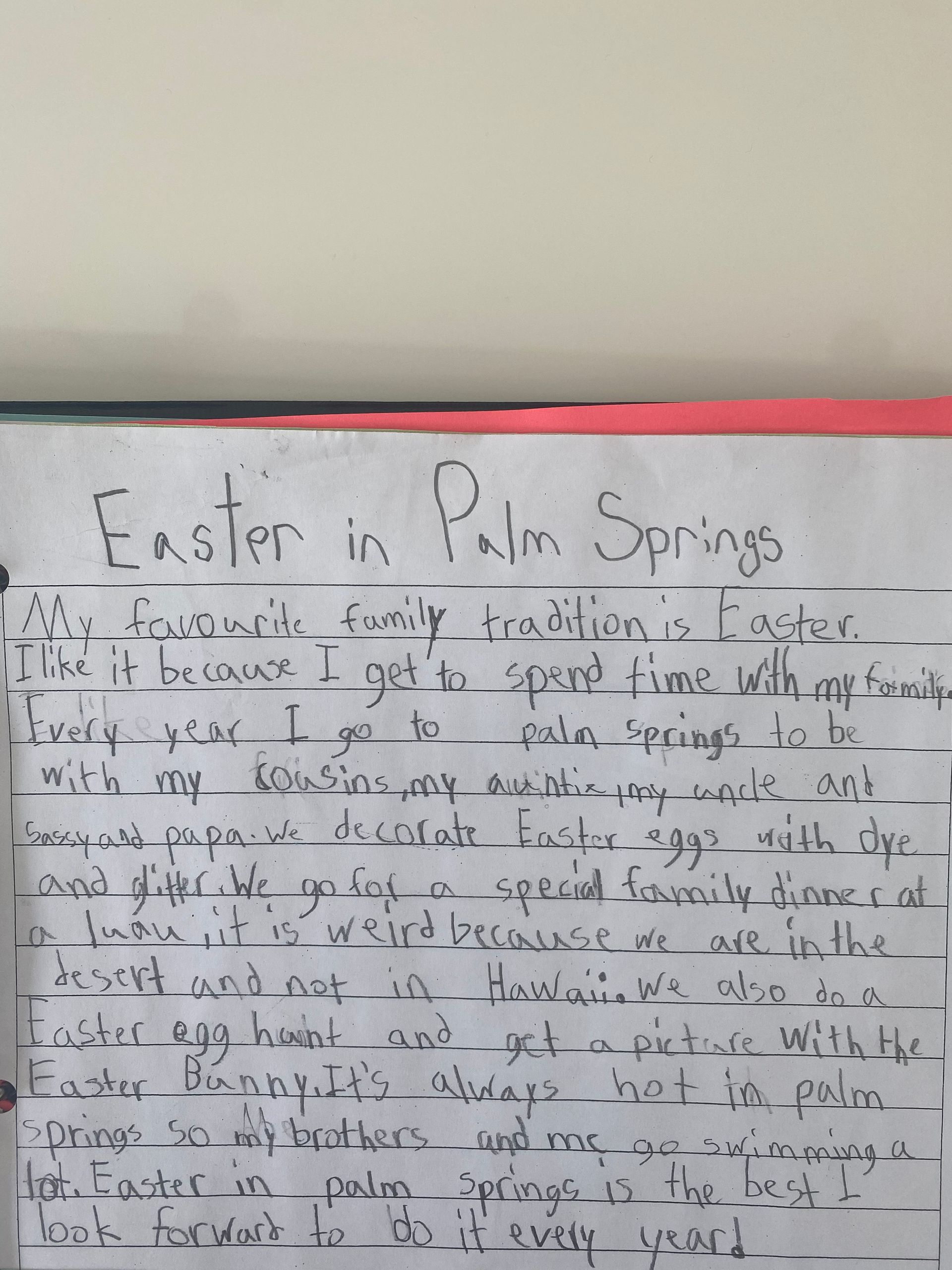
This time my remembrance is from 2 years ago and involves a school assignment my second oldest grandson, Finn, completed. It concerned writing about his favorite yearly holiday. He shared this with me when he wrote it and he gave he permission to use it in my blog.
My 5 grandchildren Finn is on the right

My own 5 wonderful grandchildren will be in the coming of age cohort that Koenen talks about. The past year has impacted every age group but I agree with Koenen that my grandkids will understand the world in a substantively different way than those from my “boomer” generation. On an optimistic note I hope Finn and his cohorts will remember the pre-Covid maskless days and the freedom that entailed.

Back in the fall and early winter of 1974 when my oldest son Noah was a newborn he had a regular “fussy time” between 5 and 7. To soothe him I would put him in the car bed (now banned for safety reasons!) and drive around the barren perimeter highway in Winnipeg where we lived. The car we rode in was a 1969 Plymouth Valiant that had push button gears. It was mostly painted a dull green except for the driver side door that was at least one shade off the rest of the body. As we circled the city the radio was permanently dialled to the daily CBC (national government radio station) evening interview program called “As It Happens”. It was the start of my long time reliance on many CBC radio shows including “This Country in the Morning” hosted by the late Peter Zosky that fed my hunger for news and editorial opinion.

Thanks to Sirius radio I can now listen to CBC in my little white sports car while I am in driving around Palm Desert where I spend the winters. One program I heard this January called “Tapestry” presented a feature on Riva Lehere. The host, Mary Haynes said this: “As a portrait artist, Riva Lehrer says faces are her whole life . She’s also someone with spina bifida – and that means people give all kinds of unwelcome attention to her body. When that happens, her face has always been her ally. With our faces necessarily hidden under masks – she is navigating a new way of connecting with the world.” (CBC Tapestry program with Mary Haynes)

Haynes noted that Riva depends on faces to inspire her artistry and that her own face is “something of a lifeline when out among strangers. She relies on it to send signals to the world.” This talented portrait artist has been fascinated and inspired by faces. With mask wearing as one of the important ways to combat the coronavirus Lehrer’s lifeline has been severed. The result she says is: “face hunger”.

So how can Riva Lehrer deal with this seemingly negative side of Covid restrictions? Not surprisingly her answer is rooted in creativity. She is excited by the design variety of the masks many people wear. “Each mask to me is like you are playing a game of Clue and you look and you think this person has chosen this mask because it expresses some essential thing about who they are.” I am looking forward to her “masked” portraits.

Riva Lehrer

Certainly postulations about what we will experience in the post pandemic world involve many more obvious and perhaps less apparent ideas than the ones I have put forward. Will we ever go back to the office? Will our big downtown buildings remain empty and lifeless ? Will online buying overshadow in person shopping? Will businesses built on digital dominate those that are not? Will remote work create new commercial hubs in the suburbs? The future will tell.

Riva Lehrer has found an inventive way to deal with a masked society that stifled her creativity. I have faith that my grandson Finn and his cohorts will find their own and original approach to their coming-of-age. I am counting on us all having smiling faces when we finally reach the post pandemic.

is loading comments...

Kathy's Blog

By K Grieve February 20, 2026
“Helen Mirren, who turned 80 in 2025, rejects the term “aging gracefully,” preferring to describe her approach as "aging with fun, commitment, and unapologetic realism". She advocates for embracing the natural process of getting older as a "beautiful thing" rather than fighting it, encouraging others to live in the moment and accept physical changes.” Aging is not for the faint of heart! It creeps up on you before you actually know it’s happening. It demands courage, boldness, wisdom, resilience, and realism. Add to that, growing older centers on the stories you carry and the memories you hold. For me, many of those lessons were learned from stories about my mother’s life, her choices, and the way she met hardship and joy. How Mom lived her life gave me my first understanding of what it means to live and to age with determination. My mother Marjorie lived until 95. Mom’s married life was pretty much emblematic of her generation. A devout Catholic, she learned the hard way that the ‘Rhythm Method’ (the practice of choosing specific days for intimacy to avoid pregnancy) of birth control was not in the least dependable. Think five kids with the last, our youngest brother Doug, born when my mom was 40. She smoked Crave M cigarettes. Back then, you could send a kid to the local drugstore with a quarter and a note to the pharmacist to get your cigarettes. Unheard of in today’s world. Almost weekly, my mom made homemade bread which filled the house with a yeasty and comforting smell. And her doughnuts were the talk of the neighborhood. Deep-fried and laid out on brown paper to cool, she dipped them in sugar, and we ate them while they were still warm. It was one of Mom’s ways of showing us love: one delicious donut at a time! My mom’s early life was less typical. Born in 1921 in Saskatchewan, she was a child of the Dust Bowl era. The middle child of six kids, she had a pleasing personality and was known as a hard worker. Perhaps that explains why, when she was just nine years old, she was sent to her Aunt Kate, where she helped in the Red and White store that Kate managed. Mom cried her eyes out for a year after she arrived because she missed home. Seven years later, she cried her eyes out when she was sent back home. My mom met those challenging years away from home with realism that helped to shape her resolve and solidified her perseverance. Her way of handling hardships and setbacks helped shape my understanding of how to approach life’s highs and lows. Looking back, it’s hard not to appreciate Mom’s handling of her early life challenges. At a time when most children are living with their parents and siblings, she learned to adapt, work, and endure separation. The tears marked her sadness, but the fact that she endured it speaks to her strength and courage. As she aged, life asked more of her, not less. She met aging the only way she knew: steadily and cheerfully. Aging didn’t soften her resolve; it strengthened it. My mother was lucky in many important ways. She was surrounded by her family and wonderful caregivers that went above and beyond the call of duty. In the last chapter of her life, she lived with my sister Gail and her partner Andrew. Helped by my other siblings, she was given something money can’t buy: a life that felt like hers. One special caregiver, Helen, understood that caring for another is more than schedules and medications. She would play one of Mom’s favourite songs, and the two would dance, smiling and giggling as they moved to the rhythm of the song. And God only knows why Mom had a parrot for a pet; a parrot that hated everyone but Mom. That bird squawked and tried to attack anyone who entered: except my mom. Strange as it may seem, that annoying parrot triggered my mom’s lifelong ability to tolerate difficult personalities. It seems to me that Mom’s life may have slowed, but it remained rich. Hearing my mom’s stories showed me that tears do not mean fragility. Tears mark courage, determination, and boldness. Now, as I grow older, I begin to see these same qualities as the core to aging. Aging hasn’t softened me: it has required me to stand more firmly, speak more directly, and, like Mom, to keep moving forward with resolve. “Do not go gentle into the night. Rage, rage against the dying of the light.” (Dylan Thomas) For most of my life, I believe I have been considered outspoken. But with aging, I have honed that characteristic to a fine point. Not long ago, I was part of a conversation about “the state of the world.” All of us were well into our seventies. We lamented days gone by and talked about how chaotic and fractured everything seems and how our reality is disturbing and disconcerting. The group represented different points of view, and the talk moved rather awkwardly but cautiously into politics. Definitive statements were made as if all would agree. Boldness took over me! I spoke up, standing my ground without apology. I felt something in me shift. It would have been easy to try to smooth things over, but instead, I chose to be bold and stand my ground. I am older now and believe aging is not about retreating from the world. It’s about resolve and courage in the face of opposition. Aging, of course, isn’t just philosophical. It shows up in physical ways. Knees and hips need replacing, bodies that don’t bounce back the way they used to, medications and vitamins galore to swallow. And tragically for some, illnesses occur that can be life-threatening. There is no bravery in pretending otherwise. But boldness and courage still have a place here. They help in deciding to face head-on what lies ahead, to ask the right questions, and to endure treatment and recovery. Aging asks us to be realistic, accepting the challenges aging can present. Aging isn’t always about changes to ones body but the evolving nature of our character. Inspired by my mother, I now feel that I am entering a period of my life where I am more determined to uphold my principles and stand up for the things that I believe. Time won’t always be on your side. It’s the simple truth, and it’s no surprise. But now and then, like my mom, there is still time for a dance!! “The years teach much which the days never know.” (Ralph Waldo Emerson)
By K Grieve January 9, 2026
Inside One Inner City School and the People Who Refused to Look Away Every morning, there are children who walk to an inner city elementary school in Edmonton Alberta carrying backpacks far heavier than books. Some of the weight is invisible: fear, hunger, worry. Burdens that no child should be forced to endure. The daily journey to school is not the “stuff” of fairytales. These young students must step carefully over sleeping bodies-the smell of alcohol and human waste filling the air. They pass by unhoused men and women bundled up in rotting blankets as they huddle on concrete doorways. People shooting up drugs is a regular scene. Some of these people the kids know-some are even family members. Shocking? unthinkable? Not for many of these children. It is simply the reality of their childhood. Inside the school walls, conversations are a chorus of languages and a mosaic of accents and cultures. Many have emigrated to Canada and English isn’t their first language. Some are Indigenous children. Some are housed in shelters or even live on their own. Most are trying to learn how to be heard, struggling with how to tell teachers they have a tummy ache or to confess they are afraid. Yet they are all determined to belong, to be noticed, to be loved and to have hope. Far too many arrive hungry, their empty stomachs growling. Food insecurity is a reality. No breakfast nor lunch packed in cute little personalized lunchboxes. Kim, a dedicated teacher at the school told me there is a breakfast program the school calls “morning meal” that is available to all kids. It may be simple but it matters greatly-yogurt, bananas and sandwiches are given to any child who needs it. There is no formal lunch program, so when extra food is available, it is saved for students without lunch. Slim pickings by most standards. During the school day, these children carry a heavy weight of uncertainty; they are not sure how to make sense of addition and subtraction, not sure what the teacher is saying, not sure where their next meal is coming from, not if the person greeting them at home is friend or foe. The uncertainty fuels their anxiety. The uncertainty robs them of joy. The uncertainty intensifies their fear. Beyond this there are stories even more disturbing. Abuse. Neglect. Physical violence. These realities have taught some children to be on their guard and to always be on the defensive. These children are not “difficult.” They are hurt. A number of the children arrive each day living in what we adults call “fight or flight”. Their antennae are on high alert. Teachers gently tell them how to breathe, how to name feelings and how to calm their bodies. As if these challenges weren’t already overwhelming, the school faces a constant battle with head lice. Despite these struggles, teachers and school administrators show up, day after day, ready to provide stability and predictability. They notice who hasn’t eaten or who is wearing the same clothes day after day. These teachers wear many hats. They are educators, counsellors and protectors. Most classrooms in this school follow a “trauma informed approach”: soft lighting, minimal clutter, consistent routines and predictable schedules. For children whose lives are filled with trepidation, school becomes their dependable constant. The goal isn’t just academics-it’s helping children feel safe and strong enough to begin to heal. Enter my friend Deb! Deb, who is affectionately called Miss Deb, volunteers at this challenging school. Two to three times a week she shows up at the school and does what committed school volunteers do. She gives her time, her heart and her presence to children who need all three. Kim says this about Deb. “I can recall a moment this fall where a student was upset. I was trying to distract him and get him thinking positively so he would calm down. I asked him to tell me things that made him happy. He listed three things. One of them was Miss Deb.” That says it all. But for Deb the stories she hears about the kids have keep her up at night, anxious and worrying. Could there be some tangible way to help? Deb knew the principal and staff had been working for a long time to secure the funding needed to build a new playground for the school. They managed to raise some of the money but were short by $35,000 to make the playground a reality. And for that reason, Deb sent out a heartfelt plea to community members to help fund the long needed play ground. This could not be some ordinary playground. Because of the surrounding environment, it needed to be “ special”: fully enclosed and carefully designed to protect the kids from hazards, like discarded needles from drug use. This playground had to be designed to prevent it from being used as sleeping spaces for the homeless or individuals affected by addiction. What should be a simple place to play must also be a protected space where children can feel safe and simply just be children. And then something special happened. Deb’s plea did not fall on deaf ears. Within minutes of Deb’s email being sent, the local community stepped up. The response was overwhelming. One donor, a well known Edmonton philanthropist, immediately responded and pledged the full $35,000! Others stepped up as well. And most recently a charitable foundation matched the $35,000 which will fund other critical school priorities. It was an astonishing level of generosity and a reminder of how much people care when they are asked. As a former teacher and one who has spent years in public service in Edmonton, I have witnessed first hand how these serious struggles intersect - each intensifying emotional and physical strain. Poverty, homelessness, addiction and family violence are profoundly intensified by our already strained and outdated support systems. Certainly, this local community response was remarkable. It’s proof of the power of a combination of compassion and generosity. This story exemplifies that help can be available when need is shared; it underscores the positive and critical impact of volunteerism. “Sometimes miracles are just good people with kind hearts” But it also leaves us with a bigger and more disturbing question: What can we do as a society to address the deep challenges that at-risk children face? How can we break the cycle that has trapped them? How can we help them envision a brighter future? A playground is a powerful beginning, but it cannot carry the weight.